



-
Technical/Service
-
Brands
-
Information
-
References
Sustainable Mobility for Modern Businesses
The shift towards electromobility is not only progressing in the private sector, but is also becoming increasingly important for companies. Climate targets, energy efficiency regulations and rising fuel costs are forcing many companies to rethink their mobility strategies. At the same time, modern technologies are opening up new economic opportunities - especially for small and medium-sized companies. "Electromobility is no longer a topic for the future, but has long since become an operational reality," says Jürgen Effner, Managing Director of TOPREGAL GmbH. "Many companies are realizing that they can not only operate more sustainably, but also more cost-effectively in the long term by using electrified means of transport and generating their own electricity." In addition to switching to electric vehicles - from delivery vans to industrial trucks - the question of power supply plays a central role. Those who charge their vehicles with their own solar power not only reduce running costs, but can also make themselves largely independent of grid fluctuations and energy price increases.
Rethinking the charging infrastructure
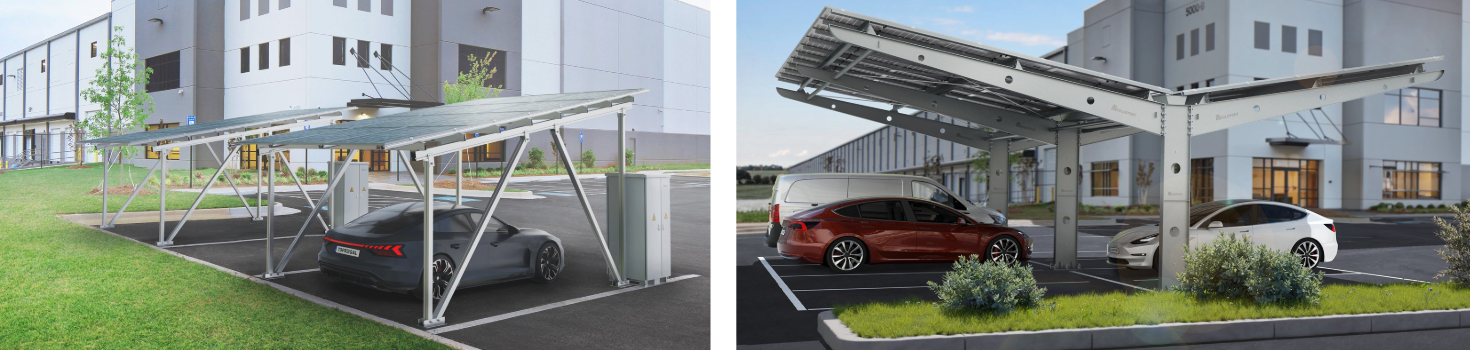
A key challenge when switching to e-mobility is the right charging infrastructure. Solar carports and solar parking canopies offer a particularly efficient solution here by combining power generation, weather protection and space utilization. "For companies with several vehicles or regular charging requirements, this is a technically and economically sensible addition," explains Effner. Thanks to their modular design, the systems can be flexibly adapted - for one or more vehicles or large parking areas on one or two sides. The electricity generated in this way can be fed directly into the company grid and used to charge electric vehicles. With the SP40/5-1 solar carport, TOPREGAL also offers an off-grid version for locations without a connection option. An integrated 40 kWh DC storage unit stores the energy generated and also enables nighttime charging - without the need for approval from the Federal Network Agency. "This makes businesses particularly flexible - even in remote areas or when there is a long waiting time for a grid connection," says Effner.
E-cargo bike with solar panel for urban mobility
In addition to stationary charging solutions, environmentally friendly means of transportation can also contribute to reducing operational emissions. Electrically powered cargo bikes are particularly suitable for short to medium transport routes - for example for routes on large company premises, internal material transport, the delivery of parcels or trips into the city or to other company locations. Thanks to their compact design, they can also be used in confined spaces and in urban traffic. Ranges can be extended with solar power. This is also the case with the LFS150-E electric cargo bike from TOPREGAL. It can be loaded with up to 150 kilograms and offers pedal assistance up to 25 km/h. An adjustable solar panel on the transport cover recharges the battery on the go. "Especially when there is no charging station nearby, this feature offers added value - an advantage that can make all the difference in day-to-day operations," explains Effner. Electric transportation also makes sense within the company: industrial trucks such as forklift trucks or pallet trucks can be operated with self-generated solar power. This reduces emissions and noise - and thus improves processes in the warehouse or in production. Integrated into a holistic energy concept, the entire internal transport system can be converted to emission-free technology.
Technically simple, economically sensible
Many companies shy away from the supposed complexity of switching to e-mobility. However, the integration of solar parking canopies for the vehicle fleet and charging infrastructure is often easier than expected: most systems have a modular design and can be installed directly on existing surfaces. "We recommend always considering the mobility strategy in the context of the company's overall energy supply," says Effner. "An economically viable system can only be created if the charging points, electricity storage system and PV system are sensibly coordinated." The combination of photovoltaics and electric transport solutions enables companies to combine ecological responsibility with economic advantage. Whether electric car, cargo bike or forklift - a well-thought-out energy concept lowers costs, reduces emissions and makes companies less dependent on the energy market. Those who act early not only strengthen their own competitiveness, but also their corporate image.