


Racking & shelving

.png)
.png)
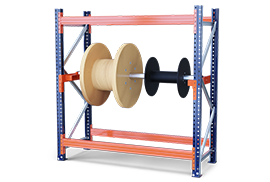

Heavy-duty racks for warehouses, workshops and commercial premises
Heavy-duty racks create order, efficient processes and secure storage in everyday commercial operations. Whether you need to store pallets, cartons, small parts, long goods or tyres, TOPREGAL offers a suitable rack system for different warehouse, workshop, dispatch and production requirements. Depending on the goods and application, choose between pallet racks, storage racks / wide-span racks, cantilever racks, shelving units, tyre racks and other specialist solutions tailored precisely to your needs. Logistics centres, workshops and industrial businesses all place high demands on load capacity, safety and flexibility. TOPREGAL provides robust, durable rack solutions for both small companies and large corporate organisations.
Why choose a TOPREGAL heavy-duty rack?
Customers often ask what distinguishes an industrial heavy-duty rack. The answer lies in the combination of quality and verified safety. Every TOPREGAL heavy-duty rack uses a robust plug-in system that enables rapid assembly while providing a high level of stability. All rack systems are tested in accordance with DGUV Information 208-061 or DIN EN 15512.
Plan instead of searching: our rack configurators
Uncertainty about dimensions and load capacities is a common problem in warehouse planning. Our online tools address precisely this issue. Use the straightforward filters to find a suitable rack in only a few clicks, or select one of the user-friendly online configurators:
- Pallet-rack configurator
- Storage-rack configurator, including a 3D corner-rack configurator
- Cantilever-rack configurator
- 3D shelving-unit configurator
Which heavy-duty rack suits my stored goods?
The most important question when selecting a heavy-duty rack is what will be stored, because no single rack system is equally suitable for every type of goods.
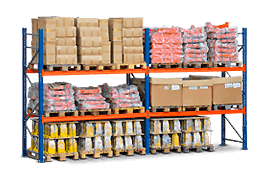
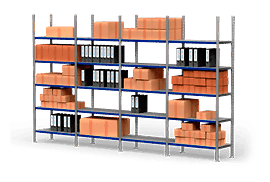
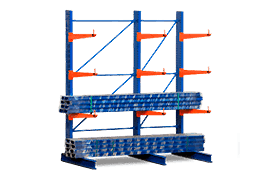
Pallet racks are the right choice for high loads stored on Euro pallets, one-way pallets and similar load carriers that are moved using forklifts. Storage racks and wide-span racks provide considerable flexibility for cartons, containers, workshop materials and larger individual items handled manually. Corner configurations are also available to make optimum use of every part of the room. Shelving units are particularly suitable for small parts, spare parts and items requiring rapid access, and are also frequently used in offices and archives. Cantilever racks are ideal for pipes, strips, timber panels and other long goods. Tyre racks provide clearly organised, space-saving storage that also protects wheels and tyres. Kanban racks fitted with compatible open-fronted storage bins are designed for the first-in-first-out principle (FIFO).
How do I determine the correct size and load capacity for a heavy-duty rack?
Many customers know what they want to store but remain uncertain about rack height, depth, number of levels or load capacity. This is where structured planning provides value. The rack should not only meet current requirements but also include reserves for future needs.
Questions to answer before purchasing:
- How heavy are the stored goods?
- How frequently must the goods be accessed?
- Will they be stored manually or using an industrial truck?
- How much width, height and depth are available?
- Should the rack be expandable later?
Why are modular heavy-duty racks so practical in everyday operations?
Warehouses grow, product ranges change and processes continue to develop. It therefore makes sense to choose heavy-duty racks that can be extended and adapted flexibly. This is a major advantage of modular systems: additional bays, levels and compatible accessories can be added as requirements increase.
TOPREGAL provides not only different rack types but also individual rack components and accessories. This is particularly useful when existing installations must be expanded or adapted to new requirements. The investment is therefore not simply in a rack, but in a solution that grows with the business.
More than racks: everything required for a functional warehouse environment
A high-quality heavy-duty rack provides the foundation, but efficient warehouse processes often require more. TOPREGAL therefore also offers compatible additions for safe, smooth operations, including protection and safety for rack systems and employees, workbenches and packing tables and mobile racks and tables.
Assembly and ongoing operation are equally important. TOPREGAL's rack-installation and inspection services help businesses equip storage areas professionally and continue using them safely over the long term.
Expert knowledge: frequently asked questions about heavy-duty racks
Customers buying heavy-duty racks often ask similar questions. The most important answers are summarised below:
Which heavy-duty rack is suitable for pallets?
Pallet racks are the appropriate solution for palletised goods. They are designed for high loads and clearly organised pallet storage.
What is the difference between a storage rack and a shelving unit?
Storage racks and wide-span racks are suitable for larger, bulkier or particularly heavy goods that are still stored and retrieved manually. Shelving units are ideal for files, small parts, cartons and products likewise removed without industrial trucks.
When is a cantilever rack or vertical rack the best choice?
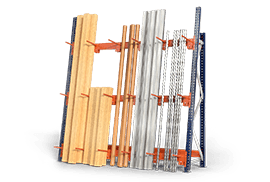
A cantilever rack is appropriate when long goods such as pipes, profiles, bars or panels are stored horizontally. If operational processes and local conditions permit vertical storage of long goods, a vertical rack is ideal.
Can I extend my heavy-duty rack later?
Yes. All TOPREGAL rack systems can be extended modularly, with compatible components and accessories allowing existing installations to be adapted to new requirements. The only exception is the small, lightweight FB500 shelving unit, which is not modularly expandable and provides an economical introduction for smaller businesses with limited storage requirements.
How do I find the right rack for my requirements?
The simplest method is to use the TOPREGAL configurators. Depending on the rack type, dimensions, layout and requirements can be planned directly.
Does TOPREGAL also provide assembly and inspection support?
Yes. Rack installation and inspection services are available for professional applications. The precise service offering may differ between EU countries and is being expanded gradually. TOPREGAL frequently works with qualified partners and may be able to provide recommendations.
What must be considered when assembling heavy-duty racks?
Several fundamental points must be observed during assembly so that each heavy-duty rack can be used safely, durably and in accordance with the relevant standards. We recommend following the guidance below for dependable operation in warehouses, workshops and dispatch areas.
► Assemble in accordance with the TOPREGAL assembly and operating instructions
Assembly and modification must always be carried out in accordance with our assembly and operating instructions. Every safety notice contained in those instructions must be observed in full. Connect the uprights to the base plates and secure them to the load-bearing floor. Attach the beams using the plug-in system and locking pins.
► Use a level, load-bearing substrate
Heavy-duty racks may be installed only on a level, stable substrate with sufficient load-bearing capacity. Uneven floors can impair stability and increase the risk of instability or tipping; levelling plates can compensate for minor irregularities (see FEM 9.831 and DIN 18202). We recommend a minimum structural floor thickness of 20 cm and a minimum drill-hole depth of 12 cm. The minimum concrete grade is C 20/25.
► Observe the maximum load capacity
Do not exceed the specified shelf load or the rack's permissible total load capacity. Distribute the load evenly across all levels to support optimum stability and a long service life.
► Do not make unauthorised structural modifications
Changes to the structure are not permitted. This includes adding extra levels and shortening, extending or modifying individual components. Such interventions can affect structural integrity, compromise safety and invalidate warranty claims.
► Maintain safety clearances
Allow sufficient clearance from traffic routes, emergency exits and other workplace equipment when positioning the rack. This keeps working areas safe and escape routes accessible at all times. Before assembly, mark the rack's precise position on the floor.
► Use suitable tools
Use only the recommended tools for assembly, generally a rubber mallet. Protective gloves are also recommended to help prevent injuries from metal edges.
► Meet labelling requirements
A load-capacity sign is mandatory. These signs are always included in our scope of delivery to support a high level of safety.
► Inspect racks regularly
Check the heavy-duty rack regularly for damage, deformation and loose connections. Depending on the application, inspections must be performed and documented at suitable intervals in accordance with the applicable occupational-safety requirements, for example DGUV provisions. Contact us for further information. These are German requirements; the applicable local requirements must be checked.