



-
Technical/Service
-
Brands
-
Information
-
References
Green mobility for companies
With the growing challenges of climate change, the topic of sustainable mobility is becoming increasingly important. Companies, with their considerable influence on the transport sector, play a major role in this. A holistic switch to electromobility offers many opportunities from which companies can benefit in the long term and in many ways. These include reducing CO₂ emissions and the ecological footprint, opening up new market segments and customer groups, increasing energy efficiency and cost savings, and strengthening the image of a sustainable and future-oriented company. However, although many prioritise climate protection in their agenda, there is often a lack of implementation. The main problems lie in the economic development of the charging infrastructure for a constant, off-grid supply of green electricity and the lack of acceptance among employees with regard to the limited range of the vehicles. Suitable measures and solutions need to be taken in this regard.
"Target direction E"
One in four companies currently has at least one electrically rechargeable car in its fleet. While the number increases with the size of the company, the average electrification rate of the fleet remains constant at only around 15 percent in an overall comparison. These results of the KfW Climate Barometer from 2023 show: There is still room for improvement. With regard to climate change, a turnaround is particularly needed in the transport sector, as motorised road traffic recently caused around 99% of all transport emissions. Companies in particular must take responsibility here: Almost 70 percent of all vehicles on the road are in commercial ownership, either as commercial vehicles or company cars, and they are used more intensively than private vehicles. This means that the commercial vehicle fleet has an important role to play in the mobility transition. Significant industry differences can be seen in the electrification of the vehicle fleet. Service companies use more e-vehicles on average than construction companies and companies in the logistics sector. However, the latter in particular rely on a diverse fleet of company cars, ground, conveyor, and transport vehicles with a long service life. For these companies in particular, switching to electrically powered vehicles is associated with high-cost savings in the long term. Social change and climate targets are also changing the demands on companies. If they switch to electric vehicles at an early stage with an eye to the future, they will benefit in the long term and will prevail against the competition. Companies that do not follow this "target direction E" risk losing their market position and losing innovative strength as electrification progresses.
Upgrade and retrofit the right infrastructure
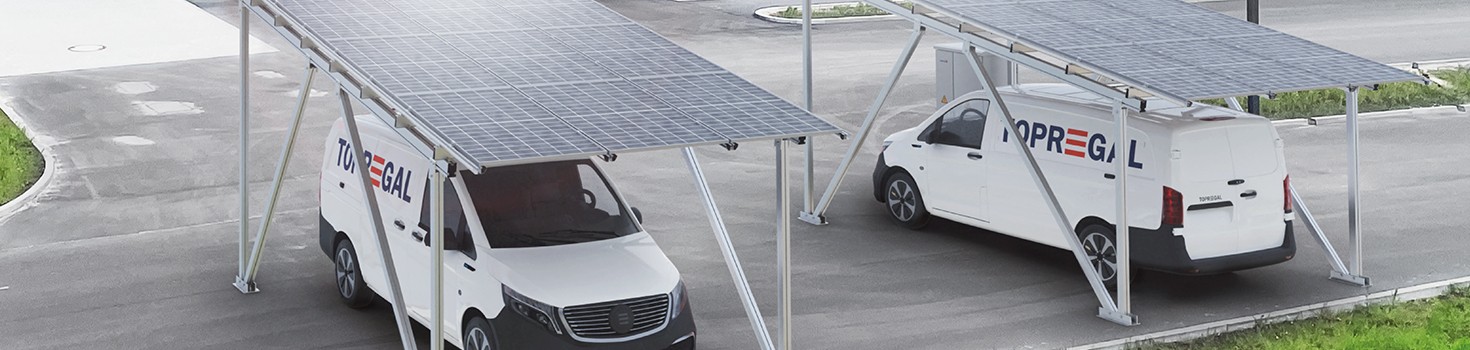
Switching to an electrically powered company fleet is associated with acquisition costs. In order to keep the cost-benefit factor high in the long term and optimise their own carbon footprint, companies need to consider a suitable infrastructure at an early stage - because moving with the times means relying on renewable energies for all areas. In order to offer sufficient charging options for electric vehicles, produce enough green electricity, and thus save costs for fossil fuels, it makes sense to first set up systems that can generate and store electricity. By installing solar systems on company premises, canopies or (hall) roofs, companies can quickly create an infrastructure. It is economical to determine the company's requirements in advance so as not to oversize the system and incur high costs. Inexpensive system formats with a modular design are practical, allowing the basic field to be enlarged with standardised add-on fields in the event of expansion. Such a system can often even cover the energy requirements of the entire company. In order to create autonomous charging facilities for electric vehicles across the board, it is an effective investment to equip a company with solar carports or solar canopies, depending on its size. Thanks to their technical design and self-sufficient power generation, state-of-the-art solar carports now make it possible to obtain all the green electricity you need. The installation of individual solar carports as a flexible charging option is particularly useful for small businesses or branched-out company premises. In addition to a wallbox for vehicles such as company cars or vans, these carports can also be equipped with additional sockets for e-pedelecs or bicycles. At the same time, a charging option is created for other battery-powered end devices, such as cleaning vehicles that ensure cleanliness on the company premises. If companies have parking areas, space-saving solar parking canopies make sense. They produce many kilowatts of electricity, which is available for company maintenance and vehicle charging. Models such as those from SoloPort are equipped with additional battery storage units to supply vehicles with electricity even overnight or when it is cloudy. For both carports and canopies, companies need to check in advance whether planning permission is required or other conditions need to be met, especially if subsidies are being applied for. If more electricity is produced with photovoltaic systems or solar roofs than is consumed, it is possible to feed this into the public electricity grid and thus supply households in the region with green energy. In this way, companies make a decisive contribution to the climate transition and create a positive and sales-promoting corporate image.
Mobilising employees
Figures from the Climate Barometer show: The trend in company cars is still strongly towards plug-in hybrids rather than purely electric cars. However, the latter, which do not require increasingly scarce fossil fuels, are the way forward. This often fails because employees are concerned that the range and battery power will not be sufficient. This not only applies to company cars, but also to commercial vehicles and other company transport vehicles. It is therefore necessary to raise awareness of the benefits of electromobility and actively communicate the tax advantages for company cars. The tax office currently assesses 0.5 percent for both hybrid and electric vehicles, which in contrast to combustion engines, which are taxed at one percent, is a relief. To provide a further incentive, employers can contribute to the charging costs. While fuel costs for company vehicles are usually reimbursed or a fuel card is issued, companies can provide a free charging infrastructure at the workplace and support charging at home. The kilowatt hour charged can be recorded directly using a separate meter or intermediate meter. However, it is less complicated for the company to pay a monthly flat rate to offset the charging costs. Employees are increasingly identifying more strongly with companies that operate sustainably. As a result, the aspect of electrification not only ensures long-term employee loyalty, but is also sometimes attractive to skilled workers when applying for jobs, meaning that companies benefit from a larger pool of applicants.
Holistic is forward-looking
From administrative buildings and company premises to production, warehousing, logistics and transportation - mobility permeates all segments of a company. Not only company cars and trucks determine the fleet, but also a large number of driving, conveying, transport and cleaning vehicles are used in operations. In order to achieve a holistic electrification of the company, it is important to focus on electromobility in all areas. The higher investment costs will pay off for companies in the long term thanks to the lower operating and maintenance costs. Here, too, it is important to check the current subsidy programs to see whether they can be used to reduce investment costs. Even when using external electricity, the charging costs for electric vehicles are on average half the price of fossil fuels for the same range. In addition, electric motors are less susceptible to wear and tear due to their design. This means that breakdowns can be avoided and maintenance costs saved. In addition to regular general inspections, it is usually the batteries that need to be replaced when they lose power. Here, too, companies can rely on inexpensive commercial vehicles such as the SolidHub models, which, with their maintenance-free lithium-ion batteries, can handle all the work that needs to be done on the company premises or construction site. From an economic point of view, companies can save on acquisition costs and still have a modern and powerful vehicle fleet. At the same time, electric vehicles improve the working environment, as employees are sometimes exposed to the poor, unhealthy air caused by combustion engines in production facilities or industrial trucks in the warehouse for many hours a day. Electrically powered vehicles produce no exhaust fumes and are quieter, resulting in a more pleasant working atmosphere. Solar-powered cargo bikes or bicycles are also efficient as alternative means of transportation in the field or on company premises: they not only reduce CO2 emissions. Particularly in the case of companies with huge premises, employees can cover distances faster and more flexibly with them than with a car and save walking and driving distances. To ease the burden, companies that want to switch to e-mobility or modernise their operating technology can take advantage of funding programs at federal and state level. For example, the Federal Ministry of Transport and Digital Infrastructure's "Electromobility in Municipalities" program supports companies with financial grants for the purchase of electric vehicles and charging infrastructure.