



-
Technical/Service
-
Brands
-
Information
-
References
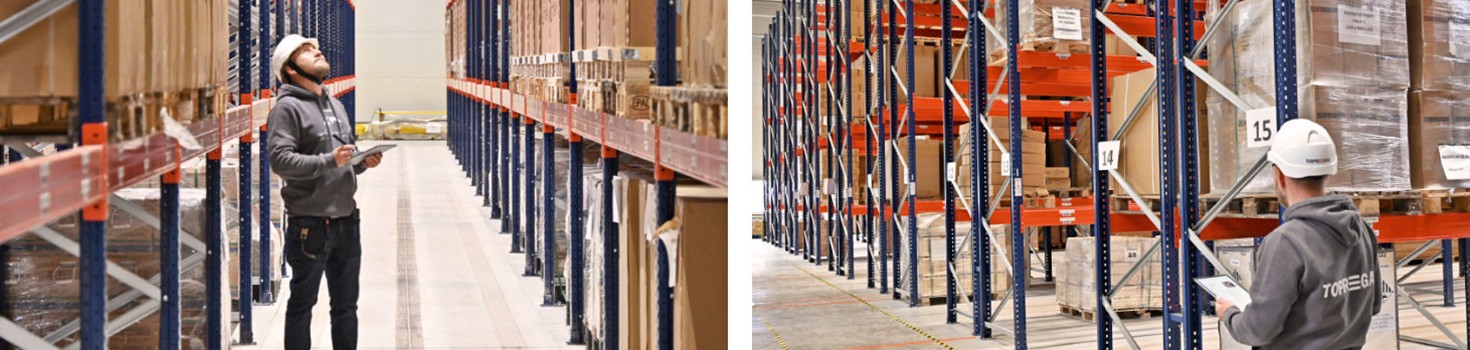
Rack Inspection: Ensuring Workplace Safety and Avoiding Fines
Responsibility goes beyond efficient processes – workplace safety is indispensable for companies. Especially in dynamic business environments, such as logistics, racking units should be regularly inspected, among other things. This is not only advisable but legally required in Germany and many European countries. "A rack inspection in accordance with the applicable regulations of DIN EN 15635 and DGUV 208-61 ensures that the legal requirements of the respective country are met," explains Jürgen Effner, Managing Director of TOPREGAL GmbH, adding: "Anyone who does not obtain the certification of safety for their racking systems at least once a year by a qualified rack inspector risks heavy fines and endangers the health of their employees." According to DIN EN 15635, all commercially used racks must be regularly inspected. This includes all storage rooms with racking systems, racks on which work equipment or materials are stored, and those used in retail facilities or agriculture.
How often should an inspection be carried out?
inspection. The former is assessed by a qualified in-house specialist in accordance with DIN EN 15635. Each rack is checked and criteria such as condition, safety, and bay load utilization are recorded. The second required form of inspection is the annual rack inspection. "This must be carried out exclusively by a rack inspector who must also present proof of competence," explains Effner. "For example, TOPREGAL's rack inspectors are trained and certified in accordance with DIN EN 15635 and are therefore qualified to carry out this inspection." It differs in content from the weekly rack inspection and must be carried out at least every twelve months. It is therefore not sufficient to have only one of the two carried out, as both examine different factors and criteria. The annual inspection checks, among other things, the proper assembly and loading of the racks, the correct application of necessary markings, and inspects the rack for possible damage such as deformations, cracks, or fractures. If an operator fails to carry out the annual rack inspection in accordance with DIN EN 15635, this can lead to violations of occupational health and safety regulations, fines, and in the event of accidents resulting in injury or death, criminal consequences.
Classification into hazard levels
IIf errors or damage are identified during inspections, they are classified into different hazard levels. The green hazard level indicates that the rack has no safety-relevant defects – these could include paint damage, for example. If a rack is assigned the orange hazard level, minor defects are present which must be marked and continuously monitored or rectified. These could be missing safety pins or a damaged impact protection element. If the classification falls under the red hazard level, the rack must be immediately unloaded until the damage has been repaired. Should no safety-relevant defects be found, the rack receives an inspection sticker at the end. "With us, companies receive the complete rack inspection including the inspection sticker and a comprehensively documented report," emphasizes Effner. This provides the company with proof of the inspection carried out and visible confirmation that the rack is compliant and safe. This gives companies a reliable basis for safe workflows and long-term operational safety in the warehouse.