Digital Displays & LED Technology


What are digital advertising displays and LED systems?
Digital advertising displays and LED systems are electronic display solutions for the dynamic presentation of advertising, information and brand content in indoor and outdoor areas. They replace static advertising media with digitally controllable, network-compatible systems with centralized content management. Depending on the design, brightness and protection class, they are suitable for stationary installations or mobile use in the professional B2B environment.
Typical areas of application are retail, shopping centers, sports facilities, trade fairs, company foyers, event areas and public facilities. The systems enable time-controlled, cross-location and target group-specific content playout in real time.
Types of advertising systems at a glance
Digital advertising screens
Digital advertising screens are free-standing displays for flexible placement in entrance areas, shop windows or sales areas. They replace classic poster stands with digital content displays.
The majority of professional models are equipped with LED technology, which ensures high brightness values and good visibility even in daylight. Some variants also work with LCD technology.
Digital advertising screens are particularly suitable for changing daily offers, short-term promotional communication, visitor guidance as well as trade fair and event applications.
Depending on the version and IP protection class, digital advertising displays are designed for permanent outdoor use. Mobile transport solutions such as castors or transport boxes enable flexible relocation.
LED video walls
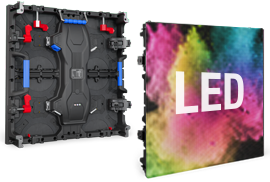
An LED video wall consists of several modular LED panels that are combined to create a large, seamless display. The size can be individually adapted to the room or area. LED video walls are characterized by high luminosity, scalability and modular expandability.
They are suitable for large sales areas, facades, events, trade fairs or sporting events where content needs to be seen from a greater distance. Depending on the version, indoor or outdoor variants are available.
LED boards
LED boards are linear digital advertising systems for stadiums, arenas and event areas. They replace static stadium boards with animated and time-controlled content.
Compared to classic advertising boards, LED boards allow changing sponsor content, defined playout intervals and the integration of several advertising partners per event.
LED trailers
LED trailers are mobile large-screen systems in which LED modules are mounted on a car trailer. They enable flexible outdoor use without a fixed installation.
Typical areas of application are open-air events, promotional campaigns, parking lots or temporary event areas. Thanks to high brightness values, content remains clearly visible even in direct sunlight.
LED cube and LED ball
LED cubes and LED balls are shape-based LED displays for eye-catching indoor presentations.
LED cubes can display content on several sides simultaneously, while an LED ball enables a 360° display that is visible from all sides. These systems are often used at trade fairs, in showrooms or in retail spaces.
Which digital advertising system is suitable for which application?
- For entrance areas and changing daily offers: Digital advertising screens
- For large-scale brand staging: LED video walls
- For sponsor integration in stadiums: LED boards
- For mobile outdoor advertising: LED trailers
- For creative presentations: LED cube or LED ball
Selection criteria for digital advertising systems
Location (indoor or outdoor)
Outdoor systems require high brightness values and suitable protection classes such as IP55 or higher.
Brightness (nits)
Outdoor areas usually require at least 3,000 nits, with direct sunlight often requiring 4,000 to 5,000 nits or more. Indoor applications usually require lower values of between 800 and 1,500 nits.
Pixel pitch and viewing distance
The pixel pitch describes the distance between two LED pixels in millimeters. The smaller the viewing distance, the smaller the pixel pitch should be.
Size of the display area
Modular LED video walls are suitable for large-scale installations, while individual displays tend to be used for selective information areas.
Installation and service access
Wall mounting, free-standing constructions or truss integration influence planning and maintenance. Front or rear access facilitates service work.
Advantages of digital advertising media in the B2B sector
Digital advertising systems enable the central, time-controlled and cross-location playout of content. Campaigns can be flexibly adapted without having to replace physical advertising media.
Compared to static advertising media, printing and assembly costs are eliminated. At the same time, an advertising space can be monetized multiple times by rotating several pieces of content or sponsors.
The scalability of digital systems enables uniform brand communication across multiple locations. LED boards and video walls offer flexible advertising integration, especially in the sports and event sector.
Frequently asked questions (FAQ)
What is the difference between LED and LCD?
An LCD display produces images with liquid crystals and a backlight. An LED video wall, on the other hand, consists of individual LED modules in which each LED illuminates itself.
What is the difference between LED boards and classic stadium boards?
LED boards show changing digital content, while classic stadium boards are statically printed and only display one motif.
When is a video wall worthwhile instead of a single display?
A video wall is suitable for large image areas, high visibility and a strong need for attention.
What brightness should an outdoor display have?
Outdoor displays should reach at least 3,000 nits, and 4,000 to 5,000 nits in direct sunlight.
What does pixel pitch mean?
Pixel pitch refers to the distance between two LED pixels in millimetres and influences resolution and viewing distance.
Are digital advertising screens suitable for continuous operation?
Professional models are designed for continuous operation. Regular cleaning and software updates ensure long-term functional reliability.
